Lifestyle Design
A Weekly Review System for Digital Nomads Who Travel Often
A useful weekly review is not a journaling ritual. It is the smallest system that keeps work, health, money, and travel friction visible while your context keeps changing.
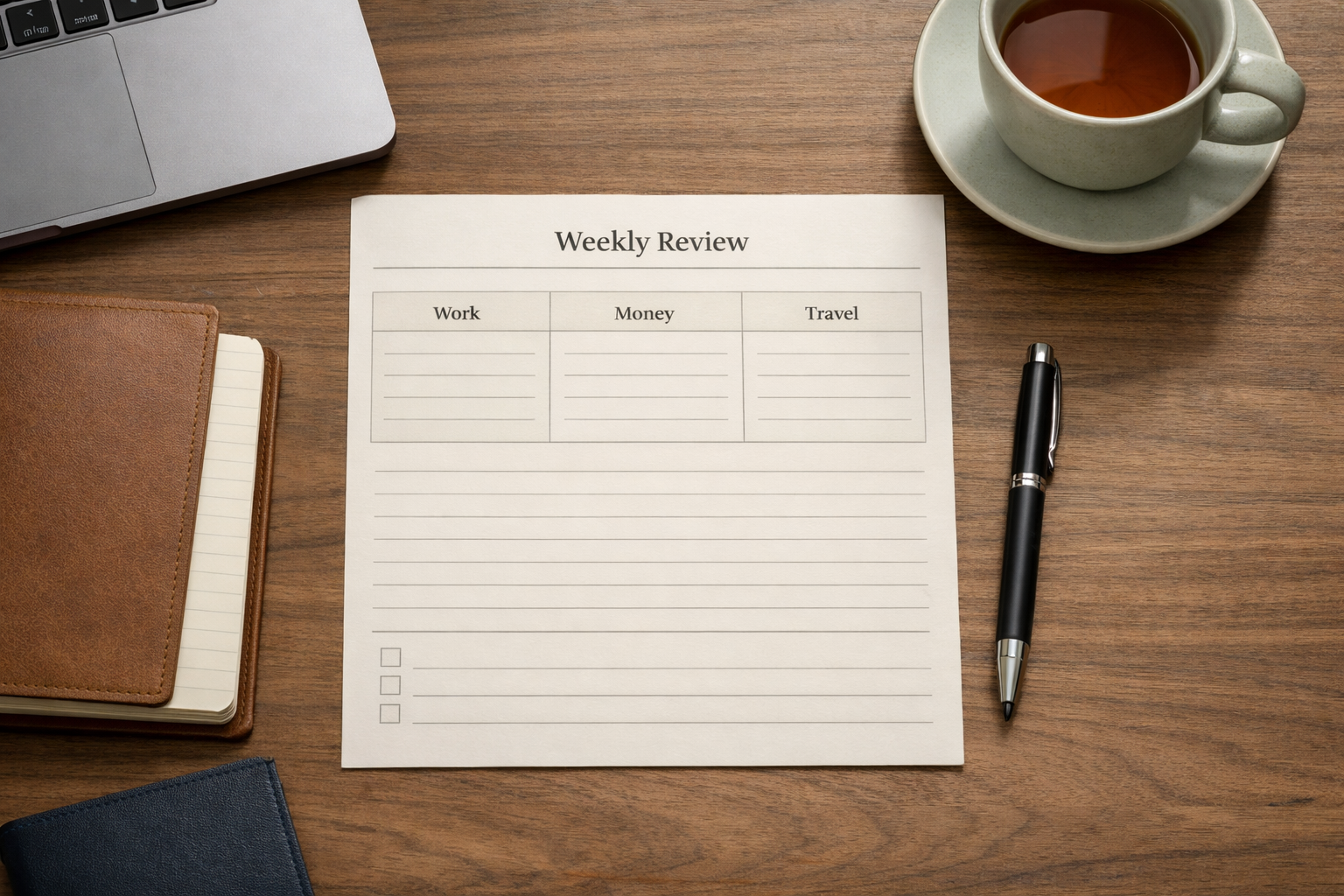
A one-page weekly review framework for digital nomads and remote operators, covering work, cash, health, relationships, and travel drift in one repeatable checkpoint.
Review the operating system before you review goals or feelings.
A useful review checks work, money, health, relationships, and travel friction on one page.
Section
Overview
Most weekly reviews fail because they are treated as a journaling ritual instead of an operating checkpoint. If you live and work across changing environments, the review has to make decisions, not just record feelings.
Section
What the review is actually for
A good weekly review protects continuity. It shows whether your work, money, sleep, movement, and relationships are still moving in the same direction after a week of travel and execution.
Rule: Review the system first, then the goals, then the calendar.
- The five-part dashboard
- Work
- Money
- Health
- Relationships
- Travel friction
Each category needs one or two signals you can check quickly. If the dashboard takes an hour to calculate, you have already lost the point of the review.
Weekly Review Score = Commitments Kept - Drift Signals - New Uncontrolled Obligations
Section
Section 1 - Finish the week honestly
List what was completed, what slipped, and what became structurally harder than expected.
Callout: Do not rename unfinished work as strategy. Mark it as unfinished and decide whether it should be cut, reduced, or rescheduled.
Section
Section 2 - Check the personal operating base
Use sleep, movement, and recovery as operational signals. CDC sleep guidance and federal activity guidance exist for a reason: weak energy changes execution quality long before it changes your self-image.
Section
Section 3 - Check cash and tax posture
For location-flexible people, the week should include a fast review of runway, major spending changes, unpaid invoices, and tax money that needs to stay ring-fenced.
IRS pay-as-you-go tax guidance matters here because tax drift usually starts long before filing season.

Section
Section 5 - Shape the next week
Choose one lead outcome, one protected work block pattern, one money action, and one recovery action for the coming week.
- The 30-minute review script
- 1) Clear inboxes and calendar residue
- 2) Update the five-part dashboard
- 3) Decide what to stop carrying
- 4) Lock the next week's lead outcome
- 5) Reserve work blocks before social or admin plans expand
- Portable thresholds that matter
- Sleep below your floor for three nights
- Runway drops below your buffer target
- No meaningful exercise for seven days
- Two consecutive weeks with no uninterrupted work block
- Repeated rescheduling of important relationships
"The weekly review is where mobile ambition becomes a governed system instead of a pile of good intentions."
Section
Travel week version
If you are moving cities, shorten the review but keep it. A 15-minute review that preserves continuity is worth more than a perfect review you skip for three weeks.
Section
Use one page
The dashboard can live in a note, spreadsheet, or paper document. The format is not the point. The point is that you can see drift while it is still cheap to correct.
Signal: If the review keeps producing the same unresolved problem, stop writing smarter notes and redesign the surrounding system.
Portable toolkit
One-page review sheet
A five-part dashboard for work, money, health, relationships, and travel friction.
Threshold rules
Simple trigger lines for when poor sleep, falling runway, or disappearing focus should change next week's plan.
Travel week version
A shortened 15-minute review that preserves continuity during move weeks and unstable schedules.
FAQ
How long should the weekly review take?
Usually 15 to 30 minutes. If it routinely takes much longer, the process is probably collecting too much detail.
Should the review live in a notebook or spreadsheet?
Either can work. The durable requirement is consistency and fast visibility, not the format itself.
Source trail
CFPB planning and savings guidance
Supports the review's money section by emphasizing goal-setting, testing, and automation rather than vague intention.
IRS pay-as-you-go tax guidance
Used to keep the tax review section grounded for self-employed readers with income that arrives without withholding.
CDC sleep guidance
Anchors the decision to treat sleep drift as an operating signal rather than a side metric.
Author
Nomad Digits Editorial Desk
Nomad Digits publishes field guides for people who work across borders. The editorial desk combines research, operating practice, and source review across work systems, recovery, banking, tax operations, and portable decision-making.
View author profile