Work Systems
Techniques to Stay Focused (When You Live and Work Anywhere)
Attention collapses faster when your workspace, schedule, and timezone keep moving. This guide ranks the highest-ROI focus controls that still work on the road.
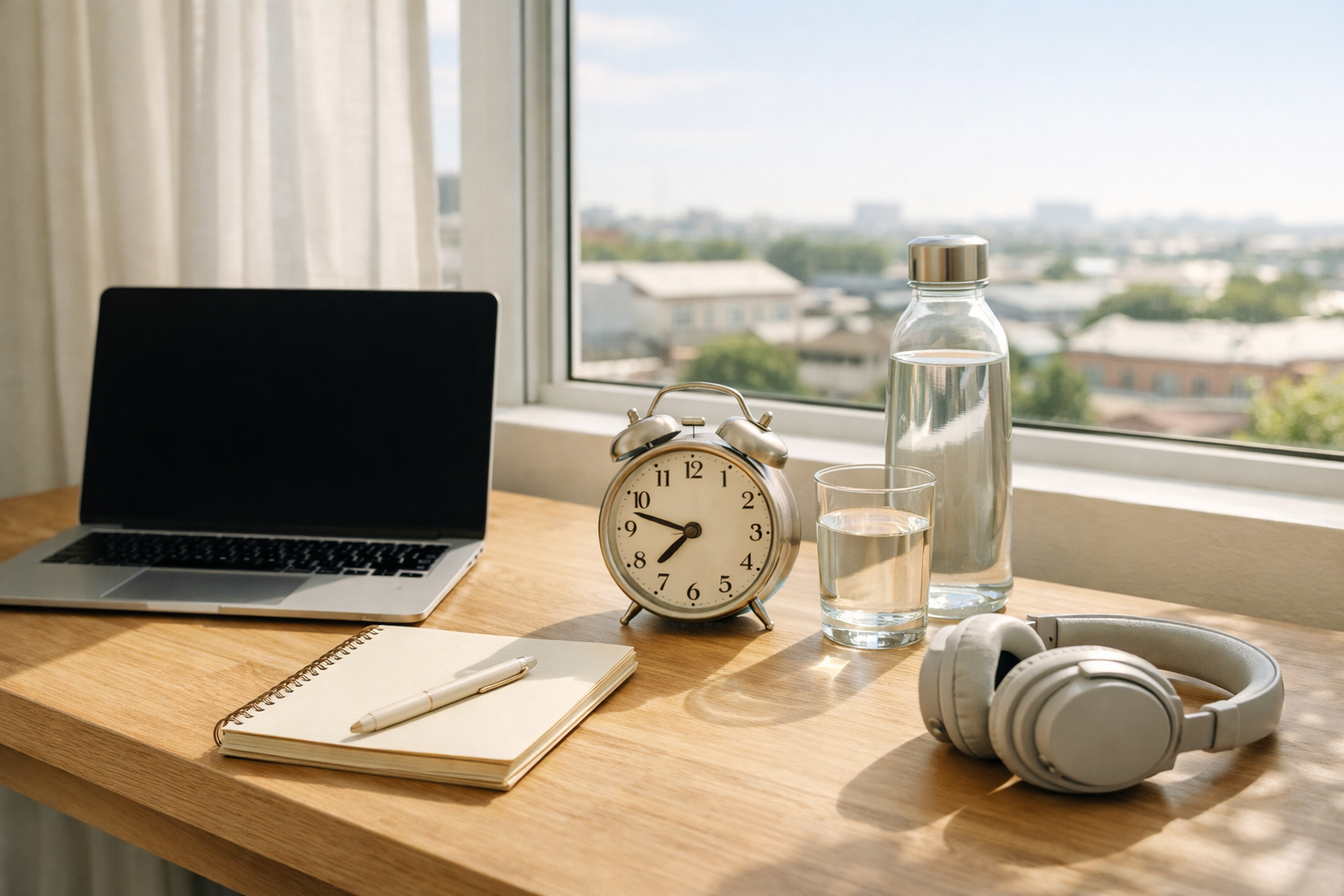
A field guide to focus for remote operators and digital nomads, with practical controls for interruptions, light timing, device placement, and portable work blocks.
Interruptions and device proximity matter more than motivational slogans about discipline.
Morning light and transition windows after travel have direct effects on usable attention.
Section
Overview
You don’t lose focus because you “lack discipline.” You lose it because nomad reality—time-zone shifts, unstable light, open-plan speech, and incessant notifications—wrecks attention continuity, energy–task fit, and environment quality. This piece is a decision-grade playbook: ranked techniques, exact setups, and measurement so you can prove gains in two weeks.
Section
The focus model you can actually use
Focus Output ≈ Time × Attention Continuity × Energy–Task Fit × Environment Quality.
Most gains come from (1) cutting interruptions, (2) aligning light/sleep so your brain is actually alert when you work, and (3) neutralizing speech noise. Interruptions measurably hurt performance and increase strain; reducing notification-caused interruptions helps both. (PMC) The mere presence of a smartphone can sap limited cognitive capacity—even when you’re not using it—so physical separation during deep work matters. (University of Chicago Journals)
Section
The ranked playbook (optimized for nomad constraints)
Each item = What to do → Why it works → Nomad adjustments → Watch-outs. Ranked by expected value (effect size × adherence × portability).
1) Hard-block notifications during deep-work windows (EV: Very High)
Do: 60–120-min blocks with OS-level Do Not Disturb/Focus; batch comms at fixed times; put the phone out of reach or in another room.
Why: Interruptions impair performance and increase strain; fewer notification events = better performance. Phone presence alone taxes cognitive resources. (PMC)
Nomad: Pre-schedule Focus modes to auto-activate by local clock after you land.
Watch-outs: Over-blocking creates coordination debt—publish your check-in windows.
2) 10–20 minutes of movement before you sit down (EV: High)
Do: Brisk walk, stairs, bands, or short bodyweight circuit; finish ~10–15 minutes pre-work.
Why: Acute exercise produces small, reliable gains in attention/executive function and faster reaction time. (Nature)
Nomad: Hotel stairwells and resistance bands remove gym dependence.
Watch-outs: Too intense → post-exercise dip. Keep it short/moderate.
3) Circadian alignment via morning light and smart evening light (EV: High)
Do: 30–60 minutes of outdoor light within 1–2 hours of local wake; in the evening, dim/warmer light and avoid bright, blue-rich light.
Why: Blue-enriched morning light improves alertness/vigilance; late-day bright light can delay melatonin and shift your clock. (PMC)
Nomad: First 48–72 hours after a big time-zone jump, treat light timing as your top lever.
Watch-outs: “More light all day” backfires; timing beats lux.
4) If-then plans plus time-blocking (EV: Medium-High)
Do: Write 3 cues and 3 responses: “If it’s 09:00 local, then start Block A (phone off-desk). If Slack pings during a block, then log it for 11:30 window.”
Why: Implementation-intention research (and MCII variants) shows reliable improvements in goal enactment with small-to-moderate effects. Newer syntheses emphasize adaptable plans. (PMC)
Nomad: Tie cues to local time and a stable anchor (first coffee).
Watch-outs: Don’t pack back-to-back blocks; leave 15–20 minutes for recovery/logging.
5) Speech-noise strategy for cafés and coworking (EV: Medium-High)
Do: Face a wall or column; sit ≥3–5 m from talkers; use ANC; prefer instrumental over lyrical music; add low-level sound-masking if allowed.
Why: The irrelevant speech effect degrades working memory/recall; ANC often improves subjective privacy/comfort even if objective recall doesn’t change; lyrics impair reading and verbal memory. (ScienceDirect)
Nomad: Carry foam tips for better ANC seal; scout “quiet corners” first.
Watch-outs: Lyrical tracks backfire on writing/coding tasks.
6) Caffeine as a dose-controlled tool, not a lifestyle (EV: Medium)
Do: 1–3 mg/kg 30–45 minutes before a hard block; cap daily at ≤400 mg; avoid within 8–10 h of target bedtime.
Why: Caffeine acutely improves attention/RT; U.S. FDA cites ≤400 mg/day as generally safe for most adults; anxiety risk rises at higher intakes. (Nature)
Nomad: Don’t chase jet lag with late-afternoon coffee.
Watch-outs: Over-use degrades sleep and can increase anxiety.
7) Mindfulness micro-practice (8–12 min) or 10–20 min daily (EV: Medium)
Do: Breath-focused micro-session before Block A, or a daily session.
Why: Randomized and controlled studies find small-to-moderate improvements in attention/executive control/working memory in healthy adults. (Nature)
Nomad: Same audio, same seat posture—consistency anchors state.
Watch-outs: Sporadic practice = weak returns.
8) Intentional low-screen evenings (EV: Medium)
Do: 2–3 evenings/week with <60 min recreational screen time; move social apps off home screen; set app-level blocks.
Why: A preregistered RCT found 3 weeks of screen-time reduction improved sleep quality, well-being, stress, and depressive symptoms (small–medium effects). Another RCT showed that blocking mobile internet for 2 weeks reduced use and improved subjective well-being. (PMC)
Watch-outs: All-or-nothing rules collapse; schedule realistic off-ramps.
9) Jet-lag protocol only on travel weeks (EV: High when relevant)
Do: Use timed light exposure (and optional melatonin) for 3–4 days post-arrival; anchor meals/sleep to destination ASAP. For trips <2–3 days, consider not shifting.
Why: CDC Yellow Book emphasizes timing light/meals/sleep to destination; for very short trips, avoid adapting. (CDC)
Watch-outs: Indiscriminate daylight can worsen misalignment; follow timing.
- Environment blueprints you can apply today
- Café / coworking (5 steps)
Seat with your back to traffic; face a wall or column.
Stay 3–5 m from talkers; avoid the center of the room.
ANC on; instrumental only; masking if permitted.
Full-screen the work window; hide the dock; phone off-desk.
Cap blocks at 75–90 minutes if lively, 120 if truly quiet.
Speech intelligibility—not just loudness—drives distraction; lyrics reduce reading and verbal memory. (ScienceDirect)
Section
Caffeine quick guide (conservative)
Start 100–200 mg; ceiling ≤400 mg/day (FDA). Avoid within 8–10 h of bedtime. (U.S. Food and Drug Administration)
Section
72-hour eastbound reset (example)
Days 1–3: morning outdoor light, dim evenings; optional correctly timed melatonin if you and your clinician deem appropriate; stabilize meals at local time. Timing matters more than gadgetry. (CDC)
Section
Measurement: prove it worked (14-day plan)
Track (daily): deep-work hours completed; average uninterrupted block length; notifications/hour (from phone OS stats); sleep duration/quality.
Protocol:
Week 1 = baseline.
Subsection
Week 2: add “notifications-off deep-work windows + morning light.”
Keep interventions that improve medians by ≥15%; next, add pre-block exercise or noise strategy.
(If you want to be extra rigorous, add a brief reaction-time check at a fixed time daily.)
Section
Why this beats generic listicles
It prioritizes the levers with human-grade evidence: cutting interruptions, optimizing light timing, and short acute exercise. (PMC)
It accounts for nomad friction (variable environments, shifting clocks) and tells you when techniques fail (e.g., lyrical music during writing, late caffeine on jet-lag days). (PMC)
- Where NomadDigits fits
- NomadDigits exists to make the above portable, cheap, and repeatable:
ND-Focus Blocks: one-click Focus schedules with published check-in windows (the boring scheduling that actually prevents coordination debt).
ND-Light Planner: simple AM/PM light timing by route and arrival time, using CDC-consistent guidance. (CDC)
ND-Noise Kit: seat-choice heuristics + masking profiles that respect the irrelevant speech effect and keep lyrics out of language tasks. (ScienceDirect)
The goal isn’t to buy gadgets; it’s to recover hours of deep work with what you already carry.
Section
Selected sources (for readers who want the receipts)
Notifications & interruptions: Reducing notification-caused interruptions improves performance and reduces strain. (PMC)
Phone presence effect: The smartphone’s mere presence can reduce available cognitive capacity. (University of Chicago Journals)
Acute exercise: Bayesian/meta-analytic evidence shows small but reliable cognitive benefits and faster reaction times. (Nature)
Light timing: Morning blue-enriched light improves alertness; late-day bright light can delay melatonin. (PMC)
Jet lag: CDC Yellow Book—time light/meals/sleep by destination; for short trips, avoid adapting. (CDC)
Open-plan speech / ANC / lyrics: Irrelevant speech harms working memory; ANC improves subjective comfort; lyrics impair reading/memory. (ScienceDirect)
Implementation intentions: Robust evidence (including MCII) that if-then plans help translate goals into action; adaptability matters. (PMC)
Screen-time reduction RCTs: 3-week reduction improves sleep quality and mental health; blocking mobile internet improves well-being. (PMC)
Caffeine: FDA guidance ≤400 mg/day; elevated anxiety risk at higher doses; attention/RT benefits in controlled settings. (U.S. Food and Drug Administration)
Portable toolkit
Portable focus block
A repeatable 60 to 120 minute deep-work block with comms windows, phone distance, and a defined shutdown.
Café and coworking checklist
A way to score seat position, speech noise, light, and interruption risk before committing to a workspace.
72-hour reset plan
A reset template for the first days after travel so focus survives timezone change instead of waiting for perfect conditions.
FAQ
What breaks focus fastest on the road?
The usual culprits are interruptions, weak sleep timing, and environments chosen for convenience instead of usable concentration.
Is device blocking enough by itself?
No. Good focus also depends on alertness, block design, and environment quality, especially after travel.
Source trail
Smartphone presence research
Used to justify physical device distance during deep work, not just notification muting.
CDC sleep and jet lag guidance
Supports the emphasis on light timing, sleep hygiene, and post-travel adjustment windows.
Attention and interruption literature
Frames interruptions as a system constraint rather than a character flaw.
Author
Nomad Digits Editorial Desk
Nomad Digits publishes field guides for people who work across borders. The editorial desk combines research, operating practice, and source review across work systems, recovery, banking, tax operations, and portable decision-making.
View author profile